
Faith, Secularism and How We Live Together: Archbishop Lépine Joins Panel Discussion in Montreal
Montreal
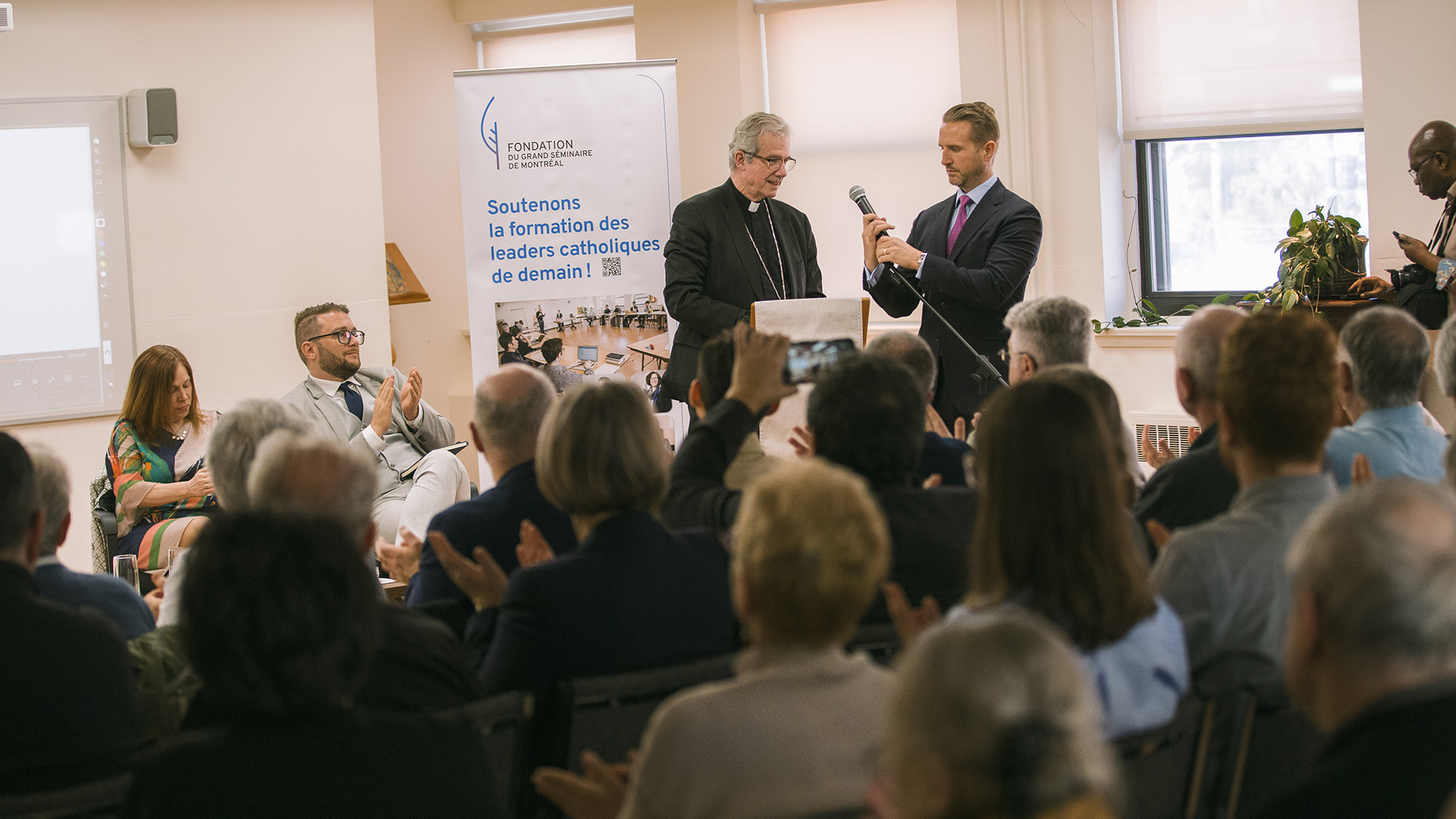
La Fondation du Grand Séminaire de Montréal hosted a new instalment of its Dialogue et espérance (Dialogue and Hope) series on Saturday, May 9, centred on the theme La laïcité au Québec : perspectives pour le vivre-ensemble (Secularism in Quebec: Perspectives for Life Together). Bringing together speakers from religious, academic and community backgrounds, the event sparked a nuanced conversation on the contemporary challenges of secularism in Quebec society.
Moderated by Francis Denis, the panel explored the place of faith and religious conviction in a secular Quebec, and what it means for people of different backgrounds and beliefs to live together in a pluralist society.
In her opening remarks, Alexandrina Diac, Executive Director of La Fondation du Grand Séminaire de Montréal, noted that the series aims to provide a space for reflection in a constantly evolving society, by bringing together a broad range of perspectives.
Toward a Just Secularism
The discussion made clear that secularism is a complex concept, defined and interpreted differently according to historical, political and cultural contexts.
Jean-Christophe Jasmin, Director of the Cardus Institute for Quebec, underlined the importance of distinguishing between state neutrality and the inherent diversity of civil society. Drawing on the work of French philosopher Paul Ricœur, he argued that the state must act as an arbiter in the service of the common good, without seeking to impose a uniform vision of values or beliefs.
Marie-Claude Lalonde, National Director of Aid to the Church in Need Canada, painted a global picture of religious freedom, noting that many communities around the world continue to live under conditions of discrimination or religious persecution, and drawing attention to the fragility of this fundamental freedom.
A Secularism Open to Dialogue
Among the most significant contributions of the day, Archbishop Christian Lépine of Montreal reflected on the place of faith in a democratic and pluralist society.
Archbishop Lépine observed that secularism should not be understood as a tool for excluding religious conviction from the public sphere, but rather as a means of upholding freedom of conscience for all. He underlined the distinction between state neutrality and the pluralist reality of civil society, made up of people whose convictions, cultures and traditions differ widely.
The Archbishop also noted that the human person cannot be neatly divided between private and public spheres. In his view, spiritual convictions shape the way a person acts, serves and contributes to society.
In his address, he also invited those present to move beyond the debate over values alone, and to consider the deeper questions of meaning and transcendence in the public sphere. "Values severed from their source will eventually wither," he said, recalling that life together depends on a profoundly human vision of the person and of human dignity.
Archbishop Lépine also stressed the importance of cultivating a genuine "culture of encounter," observing that communal life cannot be built on laws and regulations alone, but depends ultimately on dialogue, attentive listening and mutual respect.
Faith on the Ground
Alessandra Santopadre, Assistant to the Director of the Office for Cultural Communities of the Archdiocese of Montreal, brought a ground-level perspective rooted in the lived experience of believers from immigrant communities.
In the context of Quebec's debates around secularism, she noted that many immigrants feel an implicit pressure to keep their faith hidden in order to integrate into Quebec society, and that this can produce a form of inner fracture that erodes the sense of belonging.
Ms. Santopadre also highlighted the vital role of multicultural parishes as spaces of welcome, encounter and solidarity. In her view, these communities serve as genuine spaces of life together, where people of different backgrounds come to discover their common dignity.
The event concluded with a question-and-answer period, followed by Mass and a time of fellowship.
The full recording of the panel is available on YouTube (in French).
Watch La laïcité au Québec : perspectives pour le vivre-ensemble
Comment
Comment
Add new comment