
Humanism Without Transcendence: A Reflection on the Foundations of Human Dignity
Montreal
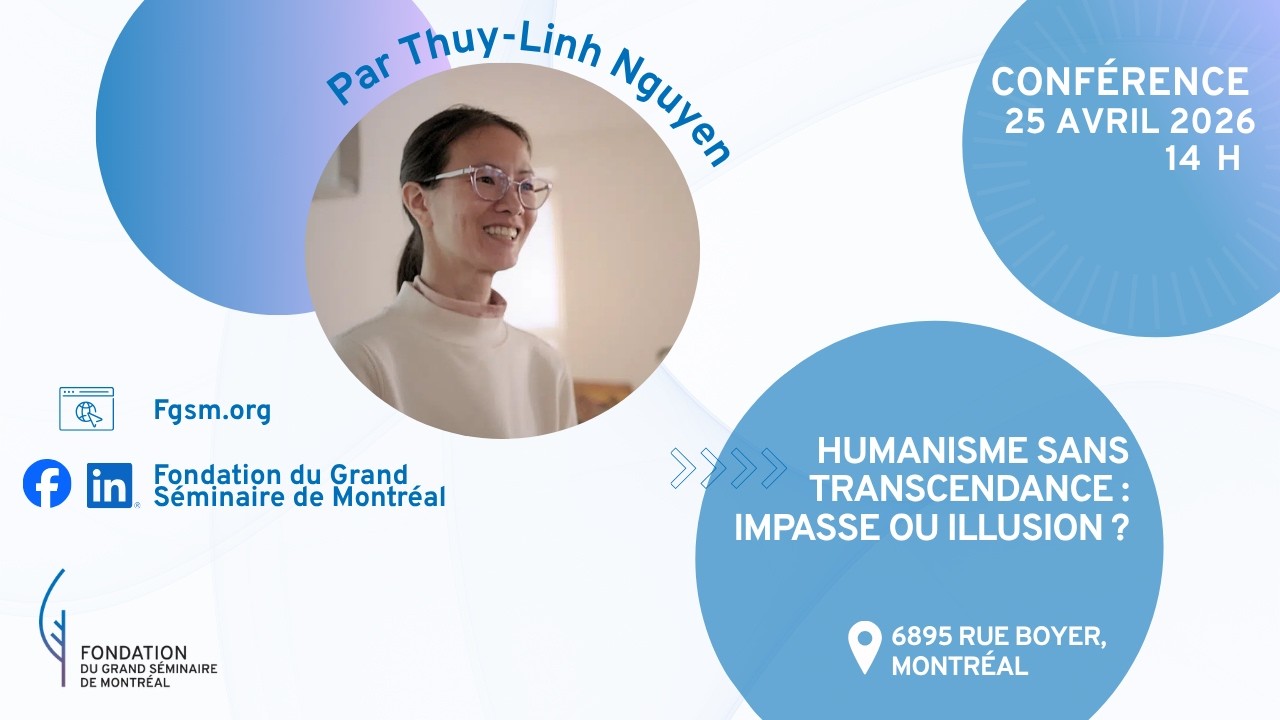
As part of its Dialogue et espérance (Dialogue and Hope) lecture series, the Fondation du Grand Séminaire de Montréal welcomed theologian Thuy-Linh Christiane Nguyen, PhD, Professor and Director of Spiritual Formation, for a conference titled « Humanisme sans transcendance : impasse ou illusion ? » ("Humanism Without Transcendence: Dead End or Illusion?"). The evening took up a question that modern culture still revisits: what happens to human dignity when God is removed from the picture?
Nguyen opened by tracing the historical arc of humanism, the tradition of thought concerned with understanding and affirming what is most fully human. From the Renaissance, which placed God at the centre and measure of human existence, to the Enlightenment, which gradually repositioned the human being as that measure himself, she mapped a decisive shift. This move from theocentrism to anthropocentrism, she argued, slowly pushed transcendence, the idea that the human person is fundamentally oriented toward something beyond himself, to the margins of how modern culture understands humanity.
Drawing on the work of Jacques Maritain and Henri de Lubac, Nguyen examined the limits of atheistic humanism. In seeking to build a vision of humanity without reference to God, she argued, certain modern ideologies did not liberate the human person but gradually undermined the very foundations of human dignity, contributing to the dehumanizing drift that left such a devastating mark on the twentieth century.
The conference also traced how successive popes have engaged these questions. From John Paul II and Benedict XVI to Pope Francis, the same call runs through their teaching: to rediscover an integral humanism, a vision of the human person as fundamentally open to God and to others. The person is more than his material conditions, more than what he produces, consumes, or achieves. His life finds its fullest meaning in relationship, fraternity, and love.
The question running beneath the entire lecture also surfaced in discussion: metaphysics, the branch of philosophy concerned with the nature of reality and what it means to be human. Without that foundation, Nguyen argued, it becomes difficult to sustain any coherent account of freedom, goodness, or human dignity. Every person, she observed, carries a deep longing for something ultimate, something beyond himself, and that longing points to an openness to transcendence that no purely human framework can fully explain or satisfy.
Nguyen concluded by inviting her audience not to underestimate what is at stake in contemporary atheism, but to put forward an open humanism, one capable of responding to the deepest aspirations of the human person. Full human flourishing, she argued, requires a movement beyond oneself, oriented toward God.
This conference was held and is available in French only. The full recording can be viewed on YouTube here:
Joanne Dorcé
Content Manager and Assistant Director,
Communications Department
Archdiocese of Montreal
Comment
Comment
Add new comment