
Three Paths to Peace: St. Francis, Pope Francis and Fethullah Gülen
Montreal
A friar, a pope and a Muslim scholar on the same stage
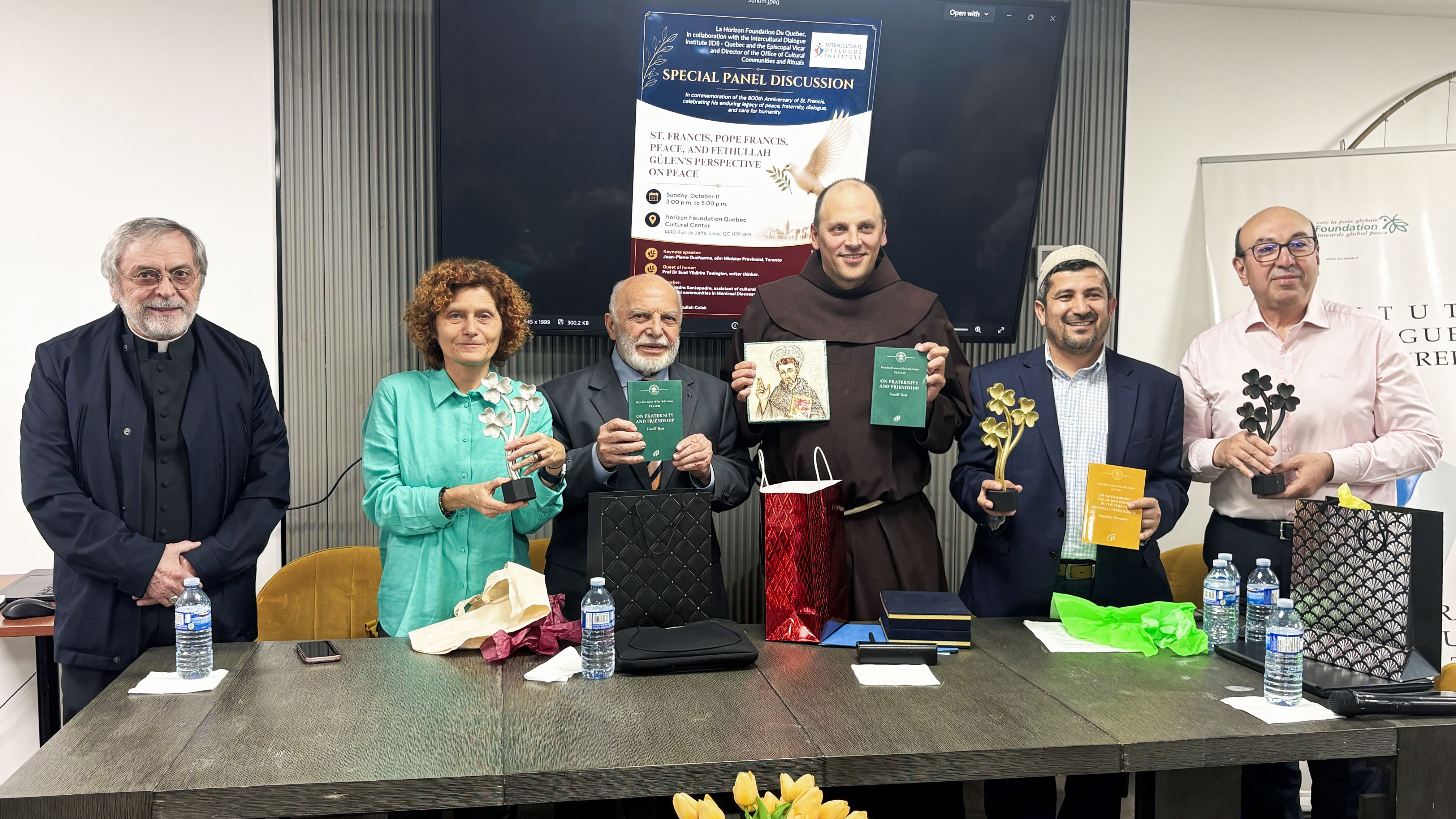
On Sunday, October 11, from 3 to 5 p.m., the Horizon Foundation Quebec Cultural Center, at 1440 Rue de Jaffa in Laval, hosted a special panel discussion on peace. Organized by La Horizon Foundation du Québec with the Intercultural Dialogue Institute (IDI) – Quebec and the Episcopal Vicar and Director of the Office of Cultural and Ritual Communities of the Archdiocese of Montreal, the event was part of the celebrations for the 800th anniversary of St. Francis of Assisi.
The title itself was a small act of peacebuilding: "St. Francis, Pope Francis, Peace, and Fethullah Gülen's Perspective on Peace." A medieval friar, the late pope and a Turkish Muslim scholar, placed side by side to show that peace has never belonged to a single tradition.
The speakers
The keynote address was given by Fr. Jean-Pierre Ducharme, OFM, Minister Provincial of the Friars Minor (Toronto). The guest of honour was Prof. Dr. Suat Yıldırım, theologian and writer. Also speaking were Alessandra Santopadre, assistant for cultural and ritual communities in the Diocese of Montreal, and Imam Beytullah Çolak.
Three starting points, one destination
The remarks on behalf of the IDI set the three figures side by side, without flattening their differences.
St. Francis: peace as encounter. In 1219, in the middle of the Fifth Crusade, the Poverello crossed enemy lines unarmed to speak with Sultan al-Malik al-Kamil. He did not end the war, but he left behind an idea that outlasted it: the other side has a face and a capacity for hospitality. Not tolerance from a distance, but sitting in the same tent.
Pope Francis: fraternity as a choice. The pope gave that instinct structure. In 2019 in Abu Dhabi, he signed the Document on Human Fraternity with the Grand Imam of Al-Azhar, Ahmad Al-Tayyeb; in 2021 he met Grand Ayatollah al-Sistani in Najaf. In the encyclical Fratelli Tutti, he invites us to "dream, then, as a single human family."
Fethullah Gülen: peace through education. For Gülen, ignorance, poverty and division feed one another, and the most lasting answer is an educated heart. Hence the schools of the Hizmet ("service") movement, bringing together students of different backgrounds. Drawing on the Sufi poet Yunus Emre ("We love the created on account of the Creator"), he condemned violence against innocents and met Pope John Paul II in 1998.
Three shared traits stood out. None of the three asks the other to stop being who they are. All treat dialogue as an action, often at personal cost. And all begin at the margins and with a kind of inner disarmament: before peace becomes a program, it is a posture of the heart.
From ideas to the city
The closing question was not whether we admire these figures, but which part of their method is within our reach, this year, in Quebec. Opening schools, parishes and cultural centres to genuine encounter; making the uncomfortable visit we have long put off; building something lasting together.
The gathering also recalled Pope Leo XIV's words in Metz on September 28: "Promoting peace is an active task." He urged young people to live it out in their families, schools and cities.
The message participants took home: peace is not the absence of difference, but what people who remain different choose to build together anyway.
Alessandra Santopadre
Assistant, Office for Cultural and Ritual Communities
Coordinator, Sponsorship Program for Refugees and Asylum Seekers
Archdiocese of Montreal
Comment
Comment
Add new comment