Migration, hope and human rights: what three continents taught us in one webinar
Montreal
Reflections on a webinar held under the theme “Human Mobility and Human Rights: A Perspective from Hope,” organized by the Socio-Pastoral Observatory on Human Mobility in Mesoamerica and the Caribbean (OSMECA), the Latin American and Caribbean Episcopal Council (CELAM), the Hope Border Institute (HOPE) and the CLAMOR Network, with the Archdiocese of Montreal
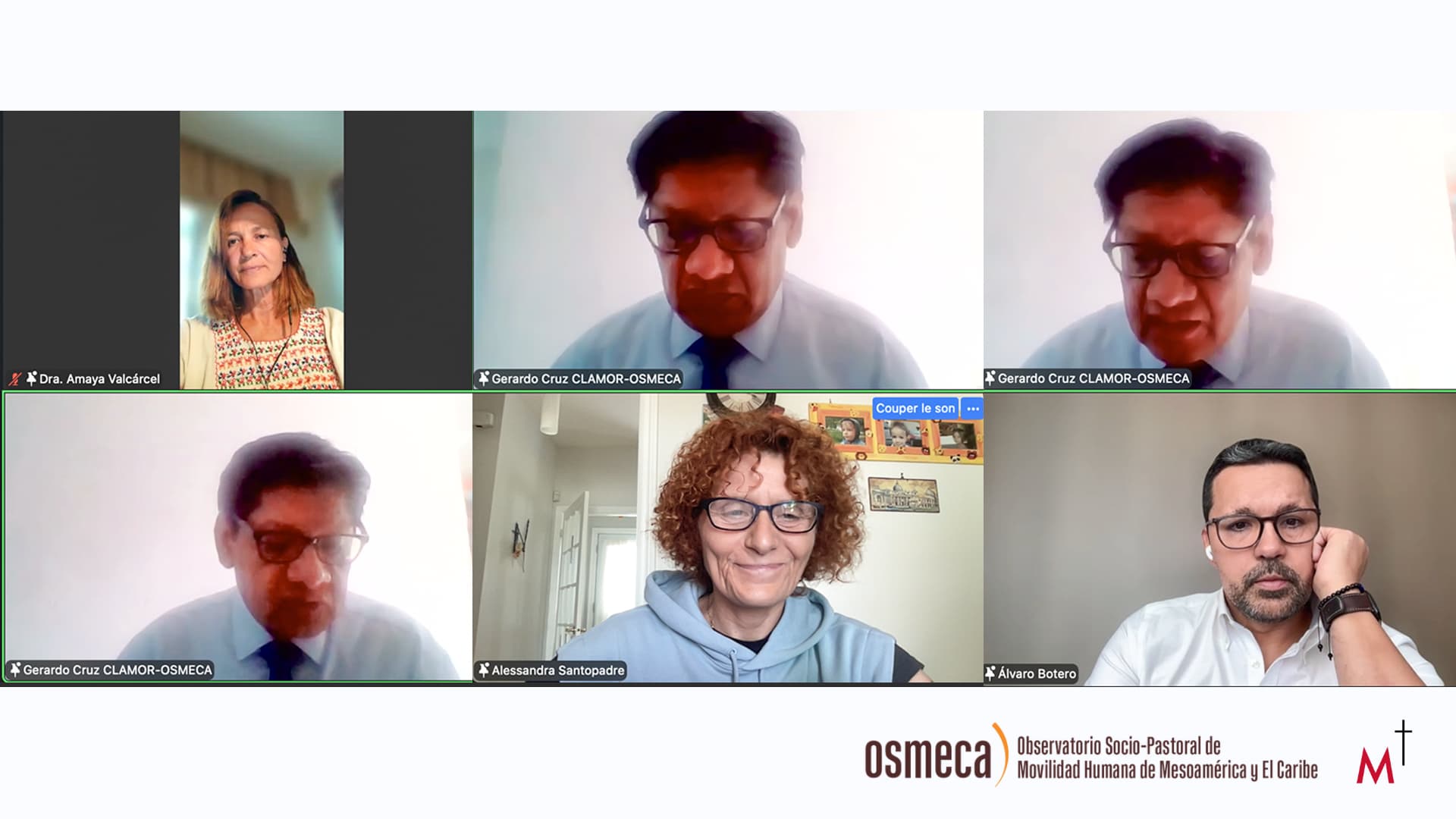
Ministry leaders, human rights lawyers and Church representatives from across the Americas met online on Thursday, Aug. 27, to explore the Church’s best pastoral practices in defending the human rights of migrants. Moderated by Gerardo Cruz González of OSMECA and the CLAMOR Network, the session brought together three speakers who, from very different contexts, arrived at the same conviction: hope is a practice built together with migrants, rather than a feeling offered to them from a distance.
The Archdiocese of Montreal was honoured to take part, and we would like to share what we took away from the discussion, along with our own contribution.
A legal battle born at a hotel window
Álvaro Botero of American University looked back to February 2025, when 299 asylum seekers from Asia and Africa were deported from the United States to Panama, a country most of them had never set foot in. It was, he noted, the first collective expulsion of third-country asylum seekers, a practice since repeated elsewhere with even greater cruelty.
Images of families pleading for help from the window of a Panama City hotel made headlines around the world. Behind those images, the asylum seekers were being held in isolation and denied due process. When the case drew attention, the authorities moved the group to a remote detention centre deep in the jungle, cutting off all access to lawyers and the press.
What followed was an improvised alliance of human rights lawyers, civil society and the Catholic Church in Panama, which within days filed urgent petitions with Panama’s Supreme Court and the Inter-American Commission on Human Rights.
Three words, three places
Amaya Valcárcel of the Dicastery for Promoting Integral Human Development offered a pastoral map drawn from three places.
Mexico taught her to stay. As the country shifts from a place of transit to one of prolonged and uncertain residence, migrants live in legal and human limbo. The Church’s task is to remain present even when it cannot solve everything, listening before acting so that no one is reduced to a case file.
Cambodia taught her to rebuild. In the Apostolic Prefecture of Battambang, decades of accompanying returning refugees show that pastoral support continues long after the emergency, helping people regain their independence through land, a co-operative or simply the means to work again.
Taizé taught her to belong. There, hospitality is a table and a life shared up close, rather than a service rendered from a distance, until the label of “migrant” fades into the simple fact of belonging to a community.
Montreal’s contribution: integration as a safeguard against exploitation
Speaking for the Archdiocese of Montreal, Alessandra Santopadre of the Office for Cultural and Ritual Communities explained why integration matters most precisely when migration policies harden. Without it, people remain dependent and rootless, and far more exposed to exploitation.
She cited the 2023 finding of Tomoya Obokata, the UN Special Rapporteur on contemporary forms of slavery, who described the low-wage stream of Canada’s Temporary Foreign Worker Program as “a breeding ground for contemporary forms of slavery.” Because a work permit tied to a single employer keeps workers from reporting abuse without risking deportation, speaking up too often leads to removal rather than help, as one Ontario farm worker put it.
She outlined five pillars of the Montreal model:
- Presence on the ground: going where migrants actually are, as at the diocesan Le Pont centre.
- Working in networks: partnering with specialized organizations such as RATTMAQ, which supports migrant farm workers in Quebec, and CAFLA, which serves Latin American families, rather than acting alone.
- Language as a door rather than a barrier: isolation is what allows exploitation to go unnoticed.
- Training ministry leaders to recognize the warning signs of human trafficking.
- Public advocacy for structural change, so that individual accompaniment becomes lasting protection.
She concluded with the Church’s four verbs: welcome, protect, promote and integrate, describing them as a single movement carried out all at once rather than four successive steps. She also recalled Pope Leo XIV’s encyclical Magnifica Humanitas, which calls the treatment of migrants and refugees a litmus test of whether a society’s “sense of justice is driven by fear or by the spirit of fraternity.”
A shared horizon
A legal battle in Panama, a pastoral journey across three continents and an anti-trafficking model in Montreal: three very different experiences that point to the same conclusion. Displacement can strip a person of dignity, independence and a sense of belonging, and the Church’s task is to help restore all three at every stage of the journey.
For the Archdiocese of Montreal, the webinar was a reminder that our work with migrant workers and newcomers is part of a far broader effort across the continent. It is guided by the conviction that our task goes well beyond managing risk: it is to protect the hope every migrant carries.
Our thanks go to OSMECA, CELAM, HOPE and Gerardo Cruz González for organizing and moderating the webinar, and to Álvaro Botero and Amaya Valcárcel for the depth of their reflections.
Alessandra Santopadre
Assistant, Office for Cultural and Ritual Communities
Coordinator, Sponsorship Program for Refugees and Asylum Seekers
Archdiocese of Montreal
Comment
Comment
Add new comment