
Now in Its Fourth Year, Montreal Joins Bishops from Across the Americas on Migration
National
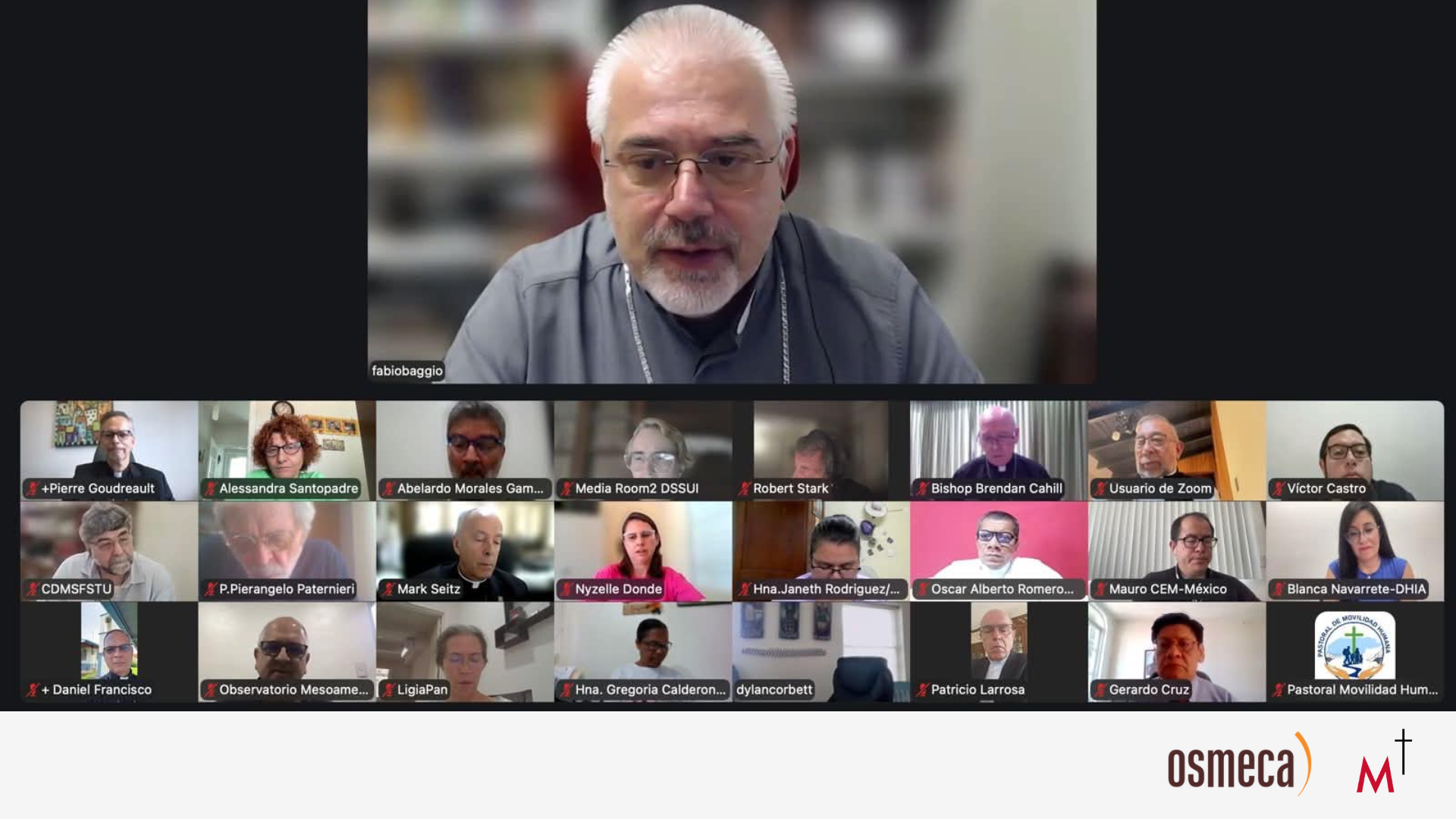
Bishops and pastoral workers from across the Americas gathered virtually on Aug. 12 for the thirteenth meeting organized by the Socio-Pastoral Observatory for Human Mobility of Mesoamerica and the Caribbean (OSMECA), a continental network coordinating the Catholic Church's response to migration. The Archdiocese of Montreal took part for a fourth year, represented this time by Bishop Pierre Goudreault, President of the Canadian Conference of Catholic Bishops (CCCB), and Father Pierangelo Paternieri, c.s., Episcopal Vicar for Cultural and Ritual Communities of the archdiocese.
The meeting drew bishops and migration ministry leaders from the United States, Canada, Mexico, and Central America and the Caribbean. Father Gustavo Meneses, OSMECA's executive director, led the sessions, sustaining a network of ecclesial collaboration along the entire migratory route that runs the length of the American continent, from south to north.
A Road Traveled Together for Years
The proceedings opened with remarks from Cardinal Fabio Baggio, Under-Secretary of the Migrants and Refugees Section of the Dicastery for Promoting Integral Human Development (Cardinal Baggio is set to become its Pro-Prefect on Sept. 1). He recalled that the Dicastery has accompanied this network since its very first meeting, born to share pastoral experience and build common ground among the continent's bishops' conferences along the migratory route. The Cardinal spoke candidly of trends now at work across much of the region — deportations, pushbacks, rising xenophobia and discrimination — and urged those present not to lose the sense of humanity now threatened by the aggression and self-interest of the moment. He also observed that the climate crisis will continue to compound the social, economic, and political pressures driving people from their homelands, and that this "ecological debt" will need to be factored into future migration policy, at a time when spaces of welcome for asylum seekers and refugees are, paradoxically, narrowing rather than widening. Cardinal Baggio closed by conveying, on behalf of Pope Leo XIV, his gratitude for the work carried out by local Churches "against the current" on behalf of migrants, holding up the OSMECA network as a model other regions of the world might follow.
Canada's Voice: A Season of Restriction, and Still, Reasons for Hope
Bishop Goudreault offered a detailed portrait of migration in Canada today: nearly a quarter of the country's population was born abroad, the highest share among G7 nations, even as recent years have brought a marked tightening of immigration policy and a record drop in arrivals to Quebec. He pointed to the pastoral challenges this creates — of Canada's 72 dioceses, only about 20 currently have a structured ministry for human mobility — and announced that the CCCB will open a new national office dedicated to this work in September.
There was hope in his account as well. Bishop Goudreault noted that despite the overall decline in arrivals, Quebec still welcomed new migrants this past year, most of them workers, alongside people arriving through family reunification and refugees — a sign that welcome, even in a more restrictive climate, remains very much alive. He observed that families arriving from Africa and Latin America in particular carry with them a deep faith capable of reviving parishes marked by heavy secularization, going so far as to call them true "missionaries" for the Canadian Church. To this he added the invaluable contribution of fidei donum priests (priests loaned by their home dioceses to serve elsewhere) from Africa, Colombia, and other Latin American countries, who today make up a significant share of the clergy serving in several dioceses, including his own. Bishop Goudreault closed with three proposals for a shared path among the Churches of the Americas: strengthening the continental network of welcome and solidarity, working together against trafficking and exploitation, and raising a common prophetic voice for human mobility that is more just and more secure.
Other Voices, Other Fronts
From the United States, Bishop Brendan J. Cahill, chairman of the U.S. Conference of Catholic Bishops' Committee on Migration, gave a particularly vivid account of the current political climate, marked by mounting pressure on migrants. He described the Bishops' Conference's concrete engagement on two fronts: defending an extension of Temporary Protected Status (TPS) for the Haitian community, for whom, he insisted, conditions for a safe return do not exist today, and fighting, alongside diocesan networks such as Chicago's Pastoral Migratoria (migrant ministry network), for the right of pastoral visitation in detention centres — an effort that has, in recent weeks, helped block the construction of new detention facilities. Bishop Cahill also cited the Mass recently celebrated in the Washington area by Cardinal Chibly Langlois of Haiti and Archbishop Thomas Wenski of Miami in solidarity with the Haitian community, along with the support it drew from some Republican political figures — a sign, he said, that even here, a change of heart remains possible. Echoing testimony offered the previous year by Dylan Corbett of the Hope Border Institute in San José, Costa Rica, he turned to the value of "small stories of hope and survival": priests who reach detainees for confession and Communion, separated families who find the strength to carry on, communities that, amid suffering, continue to bear witness that for every person, a different ending is still within reach.
Professor Gerardo Cruz González, an OSMECA researcher and professor at Mexico's National Autonomous University (UNAM), presented a reflection on the magisterial transition from Pope Francis to Pope Leo XIV, revisiting the "four verbs" — to welcome, to protect, to promote, to integrate — in light of today's new historical challenges and Pope Leo's recent encyclical on human dignity. He also invoked the weight of historical memory, tracing a line from Friar Antonio de Montesinos's 1511 denunciation of the mistreatment of Indigenous peoples in Hispaniola to today's global crisis of human mobility.
The Road Ahead
The meeting concluded with the announcement of the network's next steps: a third webinar on human rights, set for Aug. 27, and the fourteenth meeting, to be held in San Cristóbal de las Casas, Mexico, from Aug. 9 to 13, 2027.
Now in its fourth year, the Archdiocese of Montreal's presence at this continental gathering confirms a spirit of openness and collaboration with sister Churches across the Americas. As was said more than once during the meeting, the pastoral care of human mobility calls for a response that reaches beyond national and ecclesial borders, matching the scale of a phenomenon that touches the whole continent.
Alessandra Santopadre
Assistant, Office for Cultural and Ritual Communities
Coordinator, Sponsorship Program for Refugees and Asylum Seekers
Archdiocese of Montreal
Comment
Comment
Add new comment